




From Historical Ruins to a Living Landscape
Taman Sari Yogyakarta is one of the most fascinating architectural and cultural remnants of the Yogyakarta Sultanate. Built during the reign of Sultan Hamengku Buwono I in the 18th century, the complex was not merely a place of recreation and retreat for the royal family. It was also an intricate landscape in which architecture, water, gardens, and open spaces were carefully integrated.
However, the Taman Sari that we see today represents only part of what was once a much larger complex. Some of its gardens have disappeared, several structures have deteriorated, and parts of its former network of pools, canals, and landscape elements can no longer be clearly identified.
This raises an intriguing question: What did Taman Sari look like when it was first created?
Artificial Intelligence (AI) offers a new way to explore that question. By combining historical information, architectural knowledge, archaeological evidence, maps, photographs, and visual references, AI can help us create imaginative reconstructions of the landscape that may once have surrounded the royal complex.
Imagining Taman Sari as a Royal Garden
When visiting Taman Sari today, most visitors are immediately drawn to iconic structures such as Umbul Binangun, Gapura Agung, Sumur Gumuling, and its underground passages. Yet Taman Sari was never simply a collection of buildings.
At its core, it was a sophisticated landscape architecture complex combining water, vegetation, architecture, circulation routes, courtyards, and private royal spaces.
Water was one of its most important elements. Pools, channels, fountains, and waterways were not merely functional features. They also shaped the spatial experience, visual composition, orientation, and atmosphere of the entire complex.
If we imagine Taman Sari during its early period, we might picture a landscape that was considerably greener and more open than it is today. Large trees provided shade around pools and courtyards, ornamental plants filled the spaces between buildings, and calm water surfaces reflected walls, pavilions, and tropical vegetation.
Paths connected one garden space to another, while architectural structures emerged from the landscape as carefully composed elements rather than isolated buildings.
In this interpretation, Taman Sari should not be viewed merely as a “water castle,” but as an extensive royal garden complex in which architecture and landscape were inseparable.
AI as a Tool for Reconstructing the Past
Reconstructing a historical landscape is challenging because many of its original elements no longer exist. AI can help visualize conditions that cannot be directly observed today.
The purpose, however, should not simply be to create beautiful images. Instead, AI can be used to translate historical and architectural information into visual hypotheses.
A reconstruction process may begin with a combination of historical sources, archaeological documentation, existing photographs, site plans, maps, surviving architectural elements, and information about traditional Javanese gardens and landscapes.
These materials can then be translated into detailed AI prompts.
For example, a prompt might describe an 18th-century royal garden in Yogyakarta featuring large pools, water channels, tropical vegetation, flowering plants, brick and stone structures, pavilions, shaded pathways, and an atmosphere characteristic of the royal environment of the period.
AI can then generate different perspectives of the same landscape: a human-scale view from within the garden, an aerial perspective, a masterplan-like overview, or a morning scene beside one of the pools.
However, an important distinction must always be maintained:
An AI-generated image is not historical evidence.
It should be understood as an imaginative reconstruction or visual interpretation, rather than a definitive representation of what Taman Sari actually looked like in the past.
Seeing Taman Sari from Above
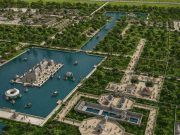
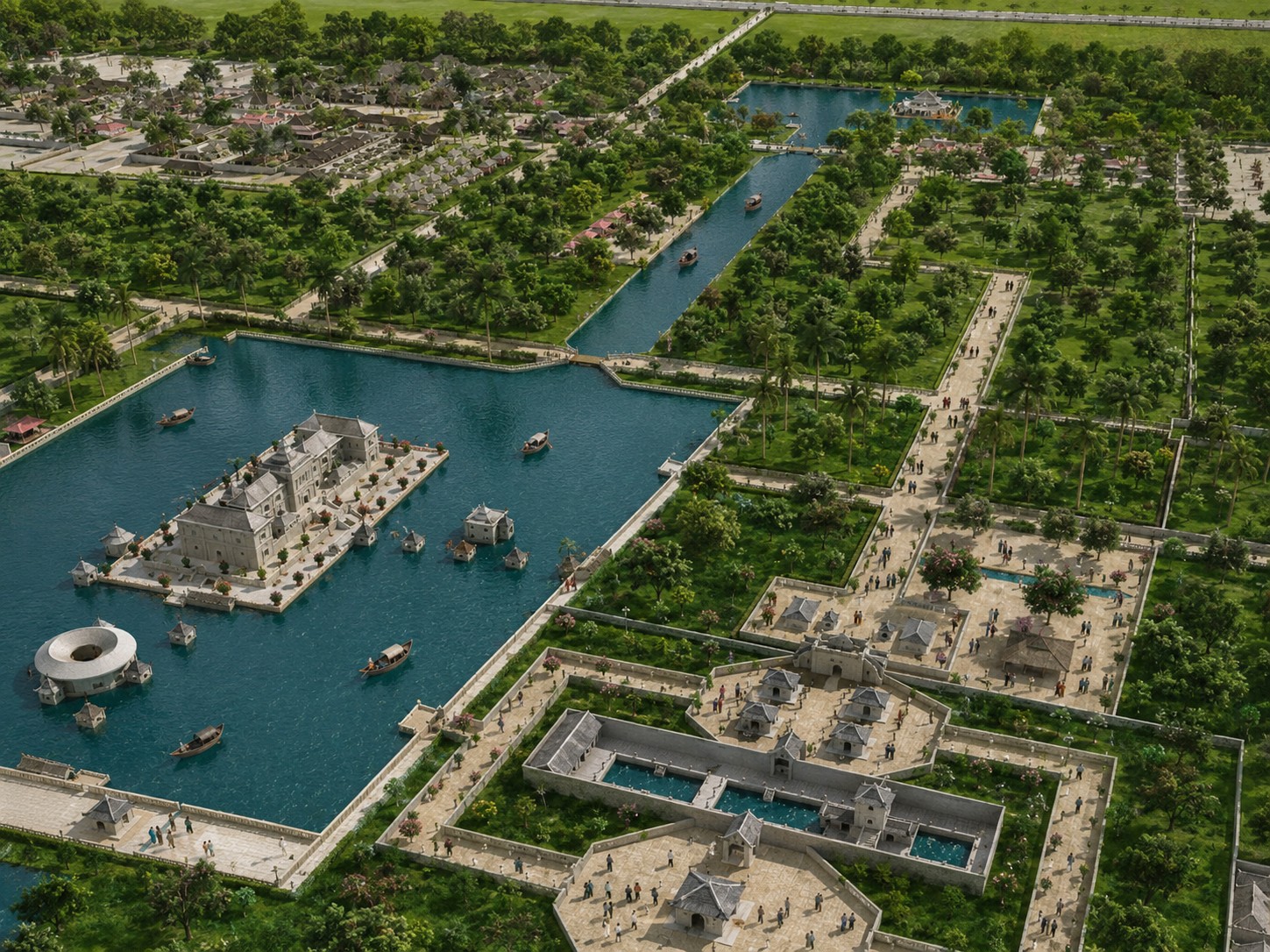
One particularly interesting approach is to visualize Taman Sari from an aerial perspective.
From above, the complex can be understood as a composition of interconnected zones. Pools and water structures form important focal points, while gardens, pathways, buildings, and courtyards create different levels of privacy and spatial hierarchy.
An aerial perspective allows us to understand the relationship between architecture and landscape.
Walls do not simply stand as architectural objects; they define spaces. Pools are not merely water features; they become visual and spatial centers. Vegetation is not simply decoration; it provides shade, establishes boundaries, frames views, and creates transitions between architectural elements.
Through AI visualization, these relationships can be explored as a living masterplan—a landscape in which buildings, water, vegetation, and circulation form one integrated composition.
Water as the Soul of Taman Sari
Any attempt to imagine the original character of Taman Sari must place water at the center of the narrative.
The pools, channels, fountains, and water systems contributed greatly to the identity of the complex.
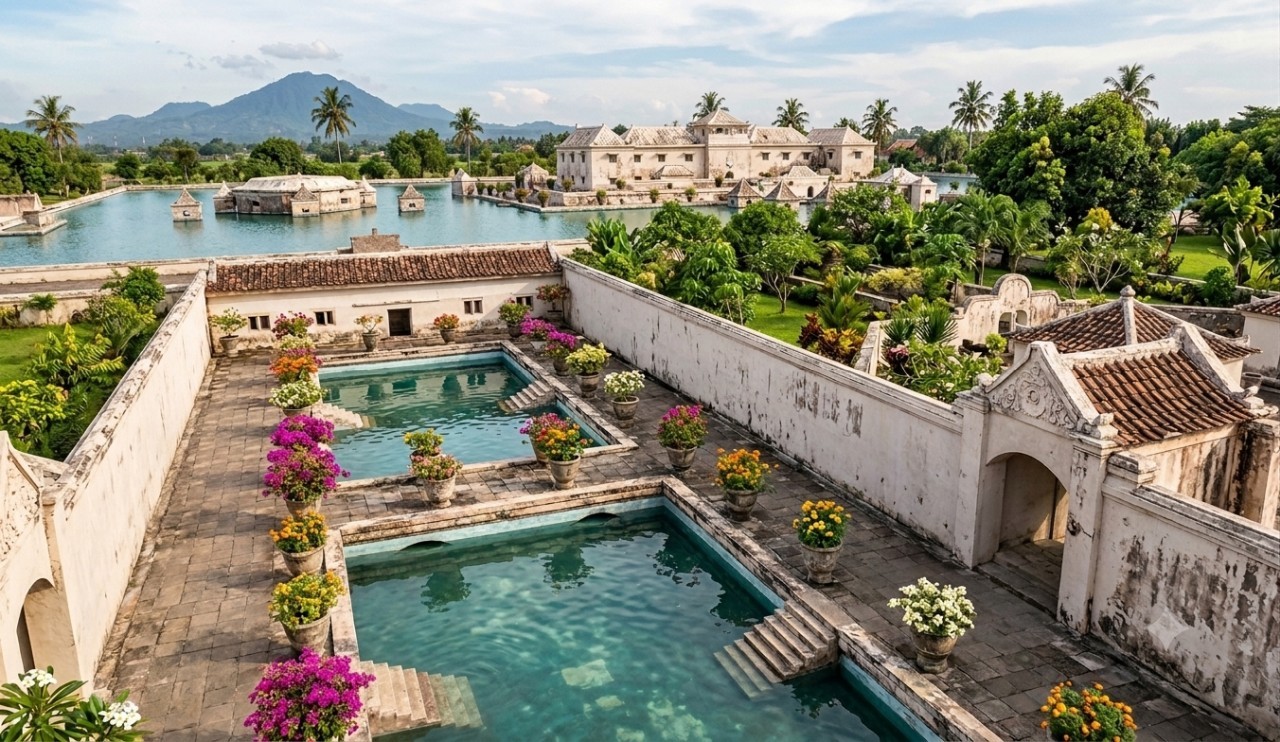
Imagine entering Taman Sari in the early morning.
The air is cool and humid. Sunlight begins to penetrate through the trees. The surface of a pool is calm, reflecting the surrounding walls and vegetation. Water gently flows through a channel. Tropical plants grow along the edges of the garden, while architectural structures appear between the trees.
This type of visualization allows AI to reconstruct not only buildings and objects, but also the atmosphere and sensory experience of the historical landscape.
The question therefore changes from:
“What did Taman Sari look like?”
to:
“What might it have felt like to experience Taman Sari as a royal garden?”
Vegetation: The Forgotten Layer of the Landscape
Architectural reconstruction often focuses heavily on buildings. Yet a garden cannot exist without its vegetation.
In imagining the early landscape of Taman Sari, AI can be used to explore possible compositions of tropical plants that would have been appropriate for the environment of 18th-century Java.
Large trees could have formed shaded spaces and established visual corridors. Flowering plants may have provided color and fragrance, while vegetation surrounding the pools would have created a soft transition between water and architecture.
Vegetation could also have contributed to the hierarchy of spaces.
More public areas might have been relatively open, while private royal spaces could have been enclosed by walls, trees, and dense planting.
Through this perspective, the garden is no longer seen as an empty space between buildings. The landscape itself becomes an essential component of the architecture.
AI as an Experiment, Not a Replacement for Historians
The use of AI in historical reconstruction comes with significant limitations.
AI can generate remarkably convincing images, but visual realism does not necessarily mean historical accuracy.
The technology may invent architectural details, plants, colors, ornaments, human figures, or landscape configurations that never actually existed. These elements are generated from patterns learned by AI rather than from archaeological evidence.
Therefore, a responsible reconstruction should distinguish between three levels of information:
First, documented facts.
These include structures, walls, pools, archaeological remains, and other elements whose existence has been established through historical or archaeological evidence.
Second, interpretation.
These are elements that can reasonably be inferred from available evidence, architectural patterns, historical context, and comparative studies.
Third, visual imagination.
These are elements introduced to create a coherent visual reconstruction when sufficient historical evidence is unavailable.
Clearly distinguishing these three levels allows AI-generated visualizations to remain engaging while avoiding the impression that every detail represents historical fact.
Toward a “Digital Taman Sari”
The greatest potential of AI emerges when visualization goes beyond static images.
We can imagine the creation of a Digital Taman Sari—a virtual reconstruction that allows people to explore possible versions of the complex during its early period.
Historical plans could be combined with three-dimensional models. Existing photographs could be used to match surviving structures with their actual locations. AI could then assist in visualizing vegetation, materials, lighting, water, and atmospheric conditions based on different historical hypotheses.
Visitors could potentially walk through the virtual garden, move from one pool to another, enter architectural spaces, and experience the relationship between Taman Sari and the broader royal complex of Yogyakarta.
In this way, technology becomes more than a tool for generating images. It becomes a medium for interpreting and communicating cultural heritage.
Imagining Without Claiming
Ultimately, reimagining the early landscape of Taman Sari with AI is a journey connecting history, architecture, landscape, technology, and imagination.
AI gives us a new ability to visualize elements that have disappeared from our view. Ruined walls can once again be imagined as part of a larger garden. Former water features can be reconstructed visually. Spaces that are now occupied by modern development can be explored through carefully defined historical hypotheses.
Yet the more realistic AI becomes, the more important it is to distinguish between evidence-based reconstruction and imaginative interpretation.
We may never be able to see the original Taman Sari exactly as it appeared in the 18th century. But by combining historical research, architecture, archaeology, mapping, photography, 3D modeling, and AI, we can develop a new way of approaching the past.
The purpose is not to claim:
“This is exactly what Taman Sari looked like.”
Instead, AI allows us to ask a more inspiring question:
“If the entire landscape of Taman Sari were still intact, what might this royal garden have looked and felt like when it was first designed and experienced?”
That question creates a space where AI can contribute—not as a replacement for history, but as a tool for reopening our imagination toward a cultural landscape that has largely disappeared.