












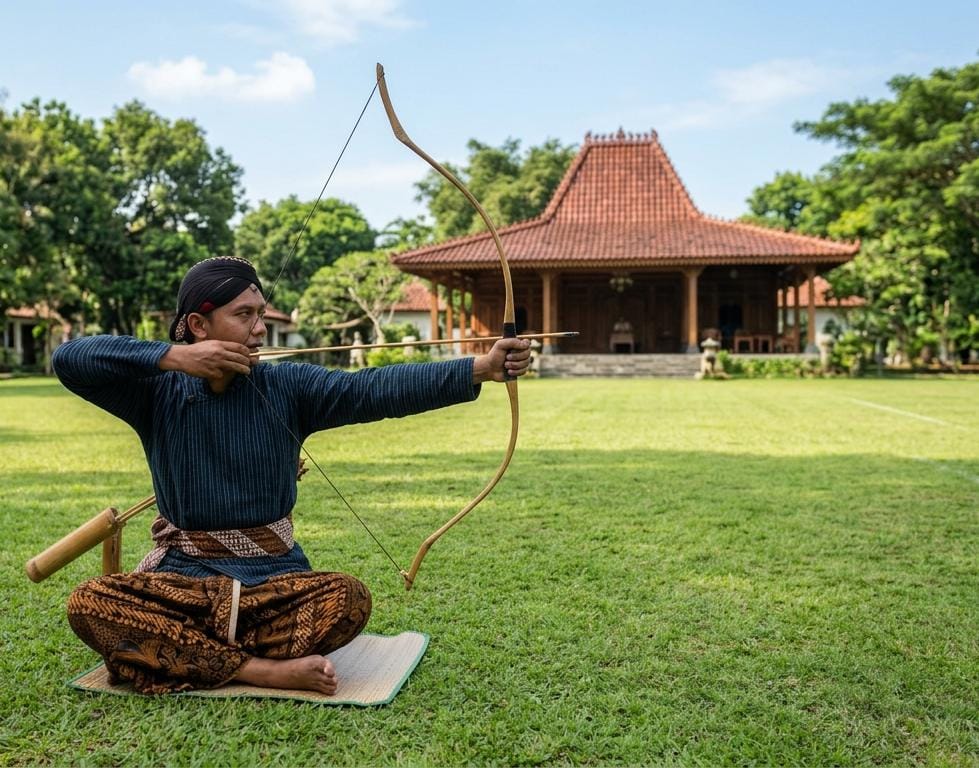
Jemparingan is a traditional form of archery originating from the Yogyakarta Sultanate, also known as Jemparingan Mataram. Unlike modern archery, in which archers normally stand and aim directly at a target, Jemparingan is traditionally performed while sitting cross-legged. More than a sport, it is a cultural practice that combines physical skill, concentration, discipline, and Javanese philosophy. The word jemparing itself refers to an arrow in Javanese. Today, Jemparingan remains an important part of Yogyakarta’s cultural heritage and continues to be practiced by communities in Yogyakarta and beyond.
The distinctive feature of Jemparingan is its unique posture and technique. The archer sits cross-legged, holding the gendewa, or bow, while drawing the jemparing, or arrow, toward the body before releasing it toward a target called a bandulan or wong-wongan. Traditional Jemparingan emphasizes feeling, concentration, and control rather than simply relying on visual aiming. The target is generally a narrow vertical object, and a successful hit may be indicated by the sound of a small bell. Traditional equipment includes a wooden or bamboo bow and specially made arrows, while participants often wear Javanese traditional clothing, creating a distinctive cultural atmosphere.
The history of Jemparingan can be traced to the Mataram tradition and, in its Yogyakarta form, to the early period of the Yogyakarta Sultanate under Sri Sultan Hamengku Buwono I (1755–1792). In its early development, archery was associated with the royal family, nobles, and palace soldiers. It served as a way to train physical ability, concentration, discipline, and the character of a ksatria, or warrior. The tradition was therefore not merely about learning how to shoot an arrow accurately, but also about developing personal qualities considered important in Javanese society.
One of the most important philosophies associated with Jemparingan is “Pamenthanging Gandewa, Pamenthanging Cipta”, which can be understood as the idea that stretching the bow should be accompanied by focusing the mind. The tradition is also closely connected with four values promoted during the reign of Sri Sultan Hamengku Buwono I: sawiji (concentration or unity of purpose), greget (spirit and enthusiasm), sengguh (self-confidence), and ora mingkuh (responsibility and steadfastness). These principles transform the act of shooting an arrow into a metaphor for life: a person must have a clear goal, focus the mind, maintain confidence, and remain committed to the path toward that goal.
Over the centuries, Jemparingan gradually moved beyond the palace environment and became a community tradition. Today, it can be found in cultural activities, competitions, and regular training sessions in Yogyakarta and other parts of Java. Its survival demonstrates how an old royal tradition can adapt to modern society without losing its essential character. In 2024, Jemparingan was officially recognized as Indonesian Intangible Cultural Heritage, further emphasizing its cultural importance. More than an ancient form of archery, Jemparingan represents a distinctly Javanese approach to balance, concentration, self-control, and harmony between body, mind, and spirit.