











Javanese script, known as Aksara Jawa or Carakan, is one of the important writing systems in the cultural history of Indonesia. It developed in Java and was traditionally used to write the Javanese language, as well as several other regional languages. Its history is closely connected to the development of Hindu-Buddhist kingdoms, particularly in Central and East Java. The script evolved from older Indic writing traditions that reached the Indonesian archipelago through cultural and religious interactions with South Asia. Over centuries, Aksara Jawa became an important medium for recording literature, religious teachings, historical accounts, royal documents, and everyday correspondence.
The development of Javanese script can be traced through a long transformation of writing traditions in Java. Ancient inscriptions from the early kingdoms of Java were generally written in forms of Pallava-derived scripts, which eventually developed into Kawi script. Kawi was widely used from approximately the eighth century onward and became an important predecessor of modern Javanese and Balinese scripts. By the later medieval period, the distinctive forms of Aksara Jawa gradually emerged. During the Islamic kingdoms and especially the Mataram period, the script continued to be used for literary and administrative purposes, even as Arabic-derived writing and later Latin script became increasingly influential.
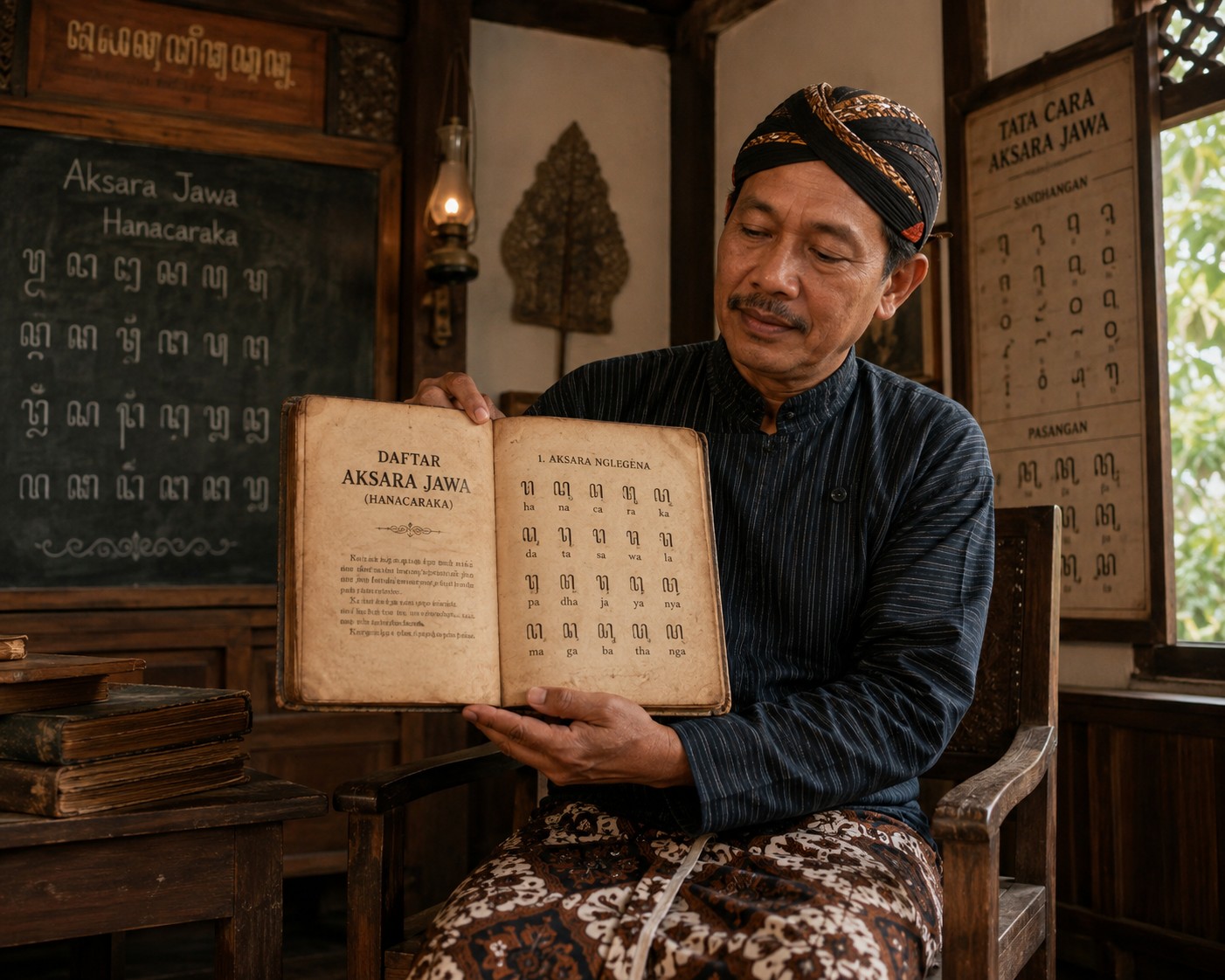
Visually, Aksara Jawa is characterized by its elegant, flowing shapes. The basic characters are called nglegena, representing consonants that inherently contain the vowel /a/. Vowels and changes in pronunciation are indicated through additional marks called sandhangan, while pasangan are used to suppress the inherent vowel of a preceding consonant and create consonant clusters. The script also contains special characters such as murda for certain proper names, swara for independent vowels, numbers, and punctuation marks. Traditional Javanese writing is normally arranged horizontally from left to right, giving manuscripts and inscriptions a distinctive visual rhythm that is both functional and artistic.
Aksara Jawa also shares important similarities with other traditional scripts in Indonesia, particularly Balinese, Sundanese, and ancient Kawi scripts. Javanese and Balinese scripts have especially strong historical and structural relationships because both developed from related Indic and Kawi traditions. Their characters often have recognizable similarities, although their shapes, conventions, and languages differ. Sundanese script, meanwhile, developed along a related historical path but has its own distinctive forms and writing conventions. More broadly, these scripts belong to the larger family of Brahmic-derived writing systems, which includes scripts found across South and Southeast Asia. This relationship can be seen in their consonant-based structures, inherent vowels, diacritical marks, and methods for combining consonants.
Today, Aksara Jawa is more than an old writing system; it is an important symbol of Javanese cultural identity. Although Latin script has become dominant in education, government, media, and everyday communication, Aksara Jawa remains visible on traditional buildings, public signs, cultural publications, artworks, and ceremonial objects. Efforts to preserve and revitalize the script include its teaching in schools, digital fonts and keyboards, cultural programs, and the use of Javanese script in contemporary design. Learning Aksara Jawa therefore means more than learning another alphabet—it provides a connection to centuries of Javanese literature, history, philosophy, and artistic expression, while keeping an important part of Indonesia’s cultural heritage alive for future generations.